
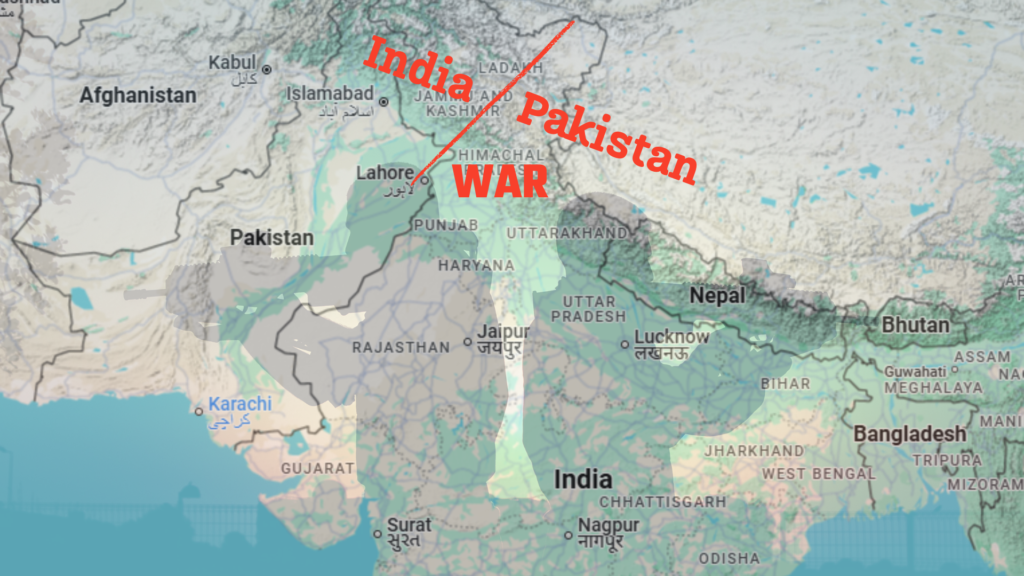
Since 1947, India and Pakistan have been locked in repeated wars and standoffs, largely over Kashmir. Here’s why India Pakistan War has not stopped yet and this decades-old conflict still matters today.
Introduction: A Border That Never Truly Settled
Ever wondered why two neighbors who gained freedom together are still at odds nearly 80 years later?
India and Pakistan—born from the same land in 1947—have been more rivals than relatives, tangled in wars, border skirmishes, and heated diplomatic face-offs. From Kashmir to Kargil, the tensions haven’t just stayed on the battlefield—they’ve shaped global geopolitics. But why does this bitter sibling rivalry still smolder in 2025?
Let’s unpack the roots, the sparks, and what’s still at stake.
A Brief Background: When the Map Was Redrawn
In 1947, the British Raj was carved into two nations: secular India and Muslim-majority Pakistan. The split wasn’t neat. Millions were uprooted overnight in one of history’s largest and bloodiest migrations.
The human toll?
- Over 14 million people displaced
- Between 200,000 to 2 million killed in communal violence
- Hundreds of princely states had to choose sides
One such state—Jammu & Kashmir—became the flashpoint that would ignite decades of hostility.
💡 Quick fact: Kashmir was a Muslim-majority region ruled by a Hindu king, who chose to join India, sparking the first Indo-Pak war.
Key Conflicts: The Wars That Shaped South Asia
India and Pakistan have officially fought four wars—but that’s just the tip of the iceberg. Here’s a snapshot:
🔥 1. First Kashmir War (1947–1948)
- Trigger: Pakistan-backed tribal invasion of Kashmir
- Result: UN ceasefire; Kashmir divided between India (J&K) and Pakistan (PoK)
🔥 2. Second War (1965)
- Trigger: Pakistan’s Operation Gibraltar in Kashmir
- Outcome: Stalemate, but deepened distrust; Tashkent Agreement followed
🔥 3. Bangladesh War (1971)
- Trigger: Civil war in East Pakistan (now Bangladesh)
- India’s role: Backed the Bengali freedom movement
- Outcome: Pakistan split in two, creating Bangladesh
- Biggest blow to Pakistan’s military and pride
🔥 4. Kargil War (1999)
- Trigger: Pakistani troops occupied Indian posts in Kargil
- India’s response: Successful military campaign to reclaim territory
- Global impact: Drew intense US and international scrutiny
Kashmir 1947: How India and Pakistan Went to War Over a Princely State
Discover how the First Indo-Pakistani War began in 1947 over Kashmir, shaping the region’s future and sparking decades of conflict between India and Pakistan.
What Sparked the Indo-Pakistani War of 1947?
Imagine the chaos right after the 1947 Partition—millions displaced, two new nations finding their footing, and then boom—a war breaks out over Kashmir. Why? Because this wasn’t just any patch of land—it was the princely state everyone wanted.
The First Indo-Pakistani War, also called the First Kashmir War, began in October 1947 and laid the groundwork for what would become one of the world’s most enduring geopolitical rivalries.
Why Did the War Happen?
It all came down to three things: territory, religion, and fear.
- Jammu and Kashmir, the largest princely state, had a Muslim majority but a Hindu ruler, Maharaja Hari Singh.
- Post-partition, princely states could join India, Pakistan, or stay independent.
- Pakistan feared that Kashmir might join India—and acted before that decision could be made official.
Pakistan’s Move
Pakistani tribal militias, backed informally by their army, invaded Kashmir. Their goal? Pressure the Maharaja into acceding to Pakistan—or take control by force.
India’s Response
Faced with an invasion, the Maharaja signed the Instrument of Accession to India on 26 October 1947. India airlifted troops into the region, turning a regional crisis into a full-scale war.
When and Where Did It All Go Down?
- When: October 1947 to January 1949
- Where: Primarily across the rugged terrain of Jammu and Kashmir, including the Kashmir Valley, Gilgit-Baltistan, and Poonch.
The conflict saw intense fighting in mountainous regions, which made logistics tough for both sides.
How Did the War Unfold?
- Initial Invasion (Oct 1947): Tribal forces supported by Pakistan crossed into Kashmir.
- Accession to India (Oct 26, 1947): Maharaja signs to join India; Indian troops enter Kashmir.
- United Nations Involvement (April 1948): The UN Security Council passed Resolution 47, calling for a ceasefire and a plebiscite (which never happened).
- Ceasefire (Jan 1, 1949): A ceasefire line was established, later known as the Line of Control (LoC).
The Result:
- India controlled two-thirds of the region: Kashmir Valley, Jammu, and Ladakh.
- Pakistan held one-third: what is now called Azad Kashmir and Gilgit-Baltistan.
Clash of Titans: The Indo-Pak War of 1965 Explained
Discover what sparked the intense Indo-Pakistani War of 1965, how it unfolded, and why it remains one of the most significant post-partition conflicts in South Asia.
When Did It All Begin?
The Indo-Pakistani War of 1965 kicked off in August 1965, following Pakistan’s covert military campaign called Operation Gibraltar. The plan? Sneak Pakistani troops disguised as locals into Jammu and Kashmir to stir up rebellion against Indian control.
But India wasn’t having it. What followed was 17 days of intense fighting, which saw both nations clash in what became the biggest tank battle since World War II.
Why Did the War Happen?
To understand the 1965 war, we need to rewind a bit.
After the partition in 1947, Kashmir became the bone of contention between the two nations. Both India and Pakistan claimed it, but the princely state had acceded to India. That didn’t sit well with Pakistan.
Fast-forward to 1965, Pakistan saw an opportunity. The Indian military was recovering from the 1962 war with China, and Pakistan believed it could incite an uprising in Kashmir. That gamble triggered a full-scale conflict.
Where Did the Battlelines Form?
While the initial conflict started in Jammu and Kashmir, it quickly spread to Punjab, Rajasthan, and even parts of Gujarat. Major battles took place in:
- Akhnoor
- Khem Karan
- Lahore Front
Tanks rolled, fighter jets soared, and civilians huddled in bunkers as one of the most intense Indo-Pak wars unfolded across multiple fronts.
How Did It End?
As casualties mounted and international pressure grew, global superpowers stepped in.
- The Soviet Union and the United States pushed both sides toward peace.
- On 22 September 1965, a ceasefire was brokered by the United Nations.
- In January 1966, both countries signed the Tashkent Declaration, mediated by Soviet Premier Alexei Kosygin.
Though the ceasefire line remained largely where it began, India was widely seen as having the upper hand when the guns fell silent.
The Aftermath: What Changed?
Here’s what the 1965 war left behind:
- Military Strengthening: India realized it needed to ramp up its defense capabilities, leading to heavy investments in military infrastructure.
- Diplomatic Wake-Up Call: The war showed both nations the risks of escalation and drew global attention to the Kashmir dispute.
- Public Sentiment: National pride surged in both countries, with stories of bravery and sacrifice becoming part of popular culture.
A Global Lens: Why Should the World Care?
You might wonder—why should someone outside South Asia care?
Here’s why:
- Kashmir remains a nuclear flashpoint. Both India and Pakistan are nuclear-armed. A conflict in this region could spiral dangerously.
- The 1965 war was a turning point in Cold War diplomacy, pulling in major powers like the U.S. and the USSR.
- It also shaped how future Indo-Pak relations would be handled—sometimes through war, often through diplomacy, but rarely with resolution.
What’s Next? Lessons Still Relevant Today
Even decades later, the shadows of 1965 linger.
With ongoing tensions in Kashmir and occasional skirmishes along the Line of Control (LoC), the legacy of the 1965 war remains more than just history.
The war is a reminder of how quickly things can escalate, and how crucial diplomacy, restraint, and global cooperation are in avoiding another all-out conflict.
Final Thoughts
The Indo-Pak War of 1965 wasn’t just about territory—it was about identity, pride, and power in a newly divided subcontinent.
As we revisit this pivotal conflict, we’re reminded how past wars shape today’s world. The lessons from 1965 are clear: military might may win battles, but only diplomacy wins peace.
How 1971 Changed South Asia Forever: The India-Pakistan-Bangladesh War
In 1971, war reshaped South Asia as India fought Pakistan and helped create Bangladesh. Here’s how it unfolded, why it matters, and what it changed forever.
Introduction: When a War Redrew the Map
What happens when politics turn brutal, millions flee their homes, and two nations clash—only for a third to be born?
That’s exactly what the 1971 Indo-Pakistani War led to—the creation of Bangladesh, a stunning military triumph for India, and one of the most decisive wars of the 20th century. Yet, the seeds of the war weren’t sown on a battlefield, but in the bitter political divide between East and West Pakistan.
Let’s unpack how it all began, who was involved, what happened during those dramatic weeks, and why the ripple effects are still felt today.
🔍 Why It Happened: A Political Explosion in Pakistan
Unlike previous Indo-Pak wars, this one wasn’t about Kashmir. The real trigger? East Pakistan’s fight for freedom.
Here’s what led to the explosion:
- East Pakistan (now Bangladesh) was culturally and linguistically different from West Pakistan.
- In the 1970 elections, Sheikh Mujibur Rahman’s Awami League won a landslide victory in East Pakistan—but West Pakistani leaders refused to hand over power.
- The result: a brutal crackdown called Operation Searchlight that targeted Bengali civilians, students, and intellectuals.
This humanitarian crisis forced over 10 million refugees to flee into India, putting immense pressure on its economy and borders.
🗓️ When & Where It Happened: A War in Two Theatres
- Start Date: December 3, 1971
- End Date: December 16, 1971
- Duration: Just 13 days—one of the shortest full-scale wars in history.
Theatres of war:
- Eastern Front: East Pakistan (now Bangladesh) – the main battlefield.
- Western Front: Along India’s border with West Pakistan – to prevent counterattacks.
Key location of surrender: Dhaka, where Lt. Gen. A.A.K. Niazi of Pakistan signed the surrender document before India’s Lt. Gen. Jagjit Singh Aurora.
🧑🤝🧑 Who Was Involved: The Main Players
- India: Led by Prime Minister Indira Gandhi and General Sam Manekshaw.
- Pakistan: Ruled by President Yahya Khan, with military leader Lt. Gen. Niazi in East Pakistan.
- Bangladesh (East Pakistan): Led politically by Sheikh Mujibur Rahman, with the Mukti Bahini (freedom fighters) fighting on the ground.
Also worth noting:
- The US and China backed Pakistan diplomatically.
- The Soviet Union supported India with military and political backing.
🔥 How It Happened: A Military and Moral Victory
- Pakistan struck first, launching air attacks on Indian bases (Operation Chengiz Khan), hoping to catch India off-guard.
- India responded swiftly, launching a two-front military campaign.
- In just two weeks:
- India captured 15,000 sq. km of territory.
- The Pakistani submarine PNS Ghazi sank mysteriously near Visakhapatnam.
- Over 90,000 Pakistani soldiers surrendered—the largest surrender since WWII.
- A new country, Bangladesh, was born on December 16, 1971.
India returned all captured land in the Simla Agreement (1972) as a goodwill gesture.
🌍 Global Significance: A Turning Point in South Asia
The war wasn’t just a local conflict—it had global consequences:
- Shifted the balance of power in South Asia, with India emerging as a dominant regional force.
- Cemented Bangladesh’s independence, changing South Asia’s political map.
- Tested Cold War alliances, with the US and China backing Pakistan, and the USSR supporting India.
- Showed the world the power of humanitarian intervention.
Even today, the 1971 war influences:
- India-Pakistan relations
- Bangladesh’s national identity
- Military strategies around the world
🔮 What’s Next: Lessons That Still Echo Today
Though the war ended over five decades ago, its lessons are still relevant:
- Political suppression leads to resistance—the denial of democratic rights in East Pakistan backfired.
- Refugee crises can escalate into war, as seen with India’s response to the influx.
- Swift, decisive military action can prevent prolonged conflict.
- Peace requires more than victory—India chose diplomacy post-war through the Simla Agreement.
As tensions still simmer between India and Pakistan, and with Bangladesh rising as an economic player, the events of 1971 are more than just history—they’re a lens to view today’s geopolitics.
🧠 Conclusion: The War That Shaped a Region
In just 13 days, the 1971 Indo-Pakistani War reshaped the subcontinent.
A military victory, a humanitarian response, and the birth of a nation—it was a rare moment where war, morality, and politics collided to change the course of history.
What if Sheikh Mujib had been allowed to lead? Would the war have ever happened? History, after all, isn’t just about what occurred—but about what could have been.
Kargil 1999: India’s Bold Defense
Explore the gripping story of the 1999 Kargil War—how India fought back, global reactions, and the aftermath that reshaped South Asia’s power dynamics.
When It Happened: The Kargil Flashpoint
In the summer of 1999, a high-altitude war broke out between India and Pakistan in the Kargil district of Jammu and Kashmir. It wasn’t a full-scale war like in the past, but it was intense, dangerous, and unexpected. The conflict officially began in May and lasted until the end of July, turning icy ridges into battlegrounds.
Where It Happened: The Cold Peaks of Kargil
The fighting took place along the Line of Control (LoC) in the Kargil sector—an area known for its rugged mountains, steep cliffs, and freezing temperatures. Pakistani troops had secretly crossed the LoC and occupied Indian military posts on high ground. Most of these areas were traditionally left unoccupied during the winter due to extreme conditions.
Who Was Involved: India vs Pakistan
- India: Responded swiftly with “Operation Vijay,” deploying air and ground forces to recapture the posts.
- Pakistan: Used its Northern Light Infantry, disguised as militants, to infiltrate Indian positions.
- Global Players: The United States and other global powers stepped in diplomatically to prevent escalation and pressured Pakistan to retreat.
Why It Happened: A Risky Gamble
So, why did Pakistan make such a bold move?
- The Kargil intrusion was likely an attempt by Pakistan to:
- Cut off Indian supply lines to Siachen Glacier.
- Internationalize the Kashmir issue by triggering a wider war.
- Take advantage of surprise and India’s reduced winter patrols.
But the gamble backfired. India not only responded militarily but also mounted a strong international diplomatic campaign.
How India Fought Back: Strategy Meets Resolve
India’s strategy involved a mix of:
- Air strikes by the Indian Air Force to weaken enemy positions.
- High-altitude assaults by ground forces to recapture peaks.
- Diplomatic offensives that exposed Pakistan’s role and isolated it globally.
Within two months, India had recaptured nearly all the positions—roughly 75%–80% of the territory initially seized.
The Aftermath: Who Lost, Who Learned?
- Pakistan’s Fallout:
- Over 4,000 soldiers were estimated killed (as later acknowledged by Nawaz Sharif).
- Morale plummeted, especially within the Northern Light Infantry.
- Pakistan faced global criticism and economic strain.
- Many soldiers’ bodies were left unclaimed, causing national outrage.
- India’s Gains:
- Reclaimed lost territory without crossing the LoC.
- Garnered global support, especially from the U.S.
- Strengthened its reputation as a responsible democracy.
For Pakistan, the war turned into a political and military debacle. For India, it was a moment of unity and strategic assertiveness.
Global Perspective: Why the World Paid Attention
The fear of two nuclear-armed neighbors going to full-scale war gave the international community chills. The U.S., along with the G8, played a quiet but firm role in convincing Pakistan to withdraw. This was one of the first times that world powers directly supported India’s stance on Kashmir.
What’s Next: Lessons from the Mountains
Even decades later, the Kargil War remains a powerful reminder of:
- The importance of military preparedness, even in extreme environments.
- The role of international diplomacy in de-escalating conflicts.
- How public sentiment and media can shape wartime narratives.
It also triggered long-term changes in India’s defense strategies, such as enhanced surveillance and year-round occupation of key outposts.
Final Thoughts
Kargil wasn’t just a military conflict—it was a turning point in South Asian geopolitics. It tested leadership, exposed fault lines, and redefined India’s defense outlook.
Kashmir: The Core of the Conflict
Even today, Kashmir remains the heart of Indo-Pak tensions. While both nations claim it entirely, the region is divided by the Line of Control (LoC).
What keeps the pot boiling?
- Cross-border terrorism: India accuses Pakistan of harboring militants.
- Military buildups: Both countries maintain large forces near the LoC.
- Nuclear backdrop: With nukes on both sides, every escalation is high-stakes.
👉 Want more on current Kashmir developments? Read our latest LoC ceasefire analysis
Beyond Borders: Global Ripples of the Conflict
Why should the world care about India-Pakistan tensions?
- Nuclear Threat: Both countries are armed and ready, making it one of the world’s most dangerous flashpoints.
- US & China Angle: The U.S. often plays mediator, while China backs Pakistan diplomatically and strategically.
- Terrorism Spillover: Global jihadist groups have found footholds in the region, raising international concerns.
📘 External read: Brookings – The dangerous India-Pakistan rivalry
What’s Next? Hope, Hostility, or Both?
Recent efforts at backchannel talks and trade diplomacy have shown glimmers of hope—but old wounds don’t heal easily.
What to watch:
- Upcoming elections in both countries could harden or soften positions.
- Water sharing tensions under the Indus Waters Treaty may spark new disputes.
- People-to-people contact, media narratives, and youth movements could be game-changers.
Final Thoughts: Can Two Brothers Reconcile?
India and Pakistan share culture, language, and even food. Yet, a border and history of violence keep them divided.
Will it take another tragedy to bring change, or can cooler heads finally prevail?
What do you think—can diplomacy outpace decades of distrust? Drop your thoughts in the comments below.